
RouteBoard: Manifest Freshness & Resequence Diffing
A high-density multi-drop delivery manifest architecture that surfaces prominent data freshness timestamps, warns couriers when route sequences are stale during underground loading bay dead zones, and provides side-by-side route diffing with offline proof-of-delivery capture.
Live Courier Manifest Simulator
Step into the delivery courier's shoes. Inspect Route #8841, open Stop #14 (450 Grand Ave), simulate entering an underground loading dock dead zone, review the dispatch re-sequence diff, and capture an offline proof-of-delivery signature.
RouteBoard Manifest Freshness & Resequence Diff
Route #8841
Downtown Commercial · 35 Stops1. Operational Scenario: High-Density Urban Courier Runs
In metropolitan logistics and multi-drop package delivery, drivers handle tight schedules of 30 to 50 stops across congested commercial downtown corridors. Tariq, driving Delivery Van #12, coordinates with a central dispatcher who monitors live traffic, building access restrictions, and urgent priority SLA shipments.
When Tariq descends into the subterranean concrete freight loading dock at 450 Grand Avenue, his smartphone loses cellular signal completely. While he is underground, a medical clinic two miles away issues an emergency courier pickup request, prompting central dispatch to re-order Tariq's remaining route sequence. In standard courier applications, the mobile device displays no indication that its cached manifest is stale, leading to wrong turns, wasted mileage, and breached SLAs.
2. The Dispatch Hurdle: Why Naive Manifests Fail
Fleet delivery applications frequently fail because they treat route schedules as static lists rather than dynamic, time-sensitive state:
- !The Silent Stale Data Trap: Drivers rely on cached stop sequences that are 30 minutes old, unaware that dispatch re-routed high-priority stops, resulting in expensive urban backtracking.
- !Jarring Sequence Swaps: Applications that blindly overwrite the route order without warning disorient couriers, who find their active navigation destination suddenly swapped mid-turn.
- !Offline Proof-of-Delivery Dropouts: When recipients sign for packages in shielded basement plant rooms, fragile apps fail to store the signature bitmap, forcing couriers to make awkward second trips.
3. The Architecture: Manifest Freshness & Side-by-Side Diffing
RouteBoard treats data freshness as a first-class citizen in both the mobile interface and the local database schema:
Core Architectural Pillars
4. Demonstrated UX Decisions in the Interface
An amber banner notifies the driver (“STALE CACHE: Synced 24m ago”) with a 1-tap shortcut to inspect pending dispatch sequence changes.
Couriers see exactly what shifted (e.g. Stop #14 promoted to Priority Stop #1) with clear visual color coding before accepting.
5. Interface State Map & Exported Screens
Direct pixel exports generated from the interface state machine:

Ordered 35-stop delivery schedule with live sync timestamp badge and package counts.

Access gate codes, freight elevator instructions, and required recipient action list.

Amber alert highlighting 24-minute sync lapse and flagging dispatch priority stop updates.
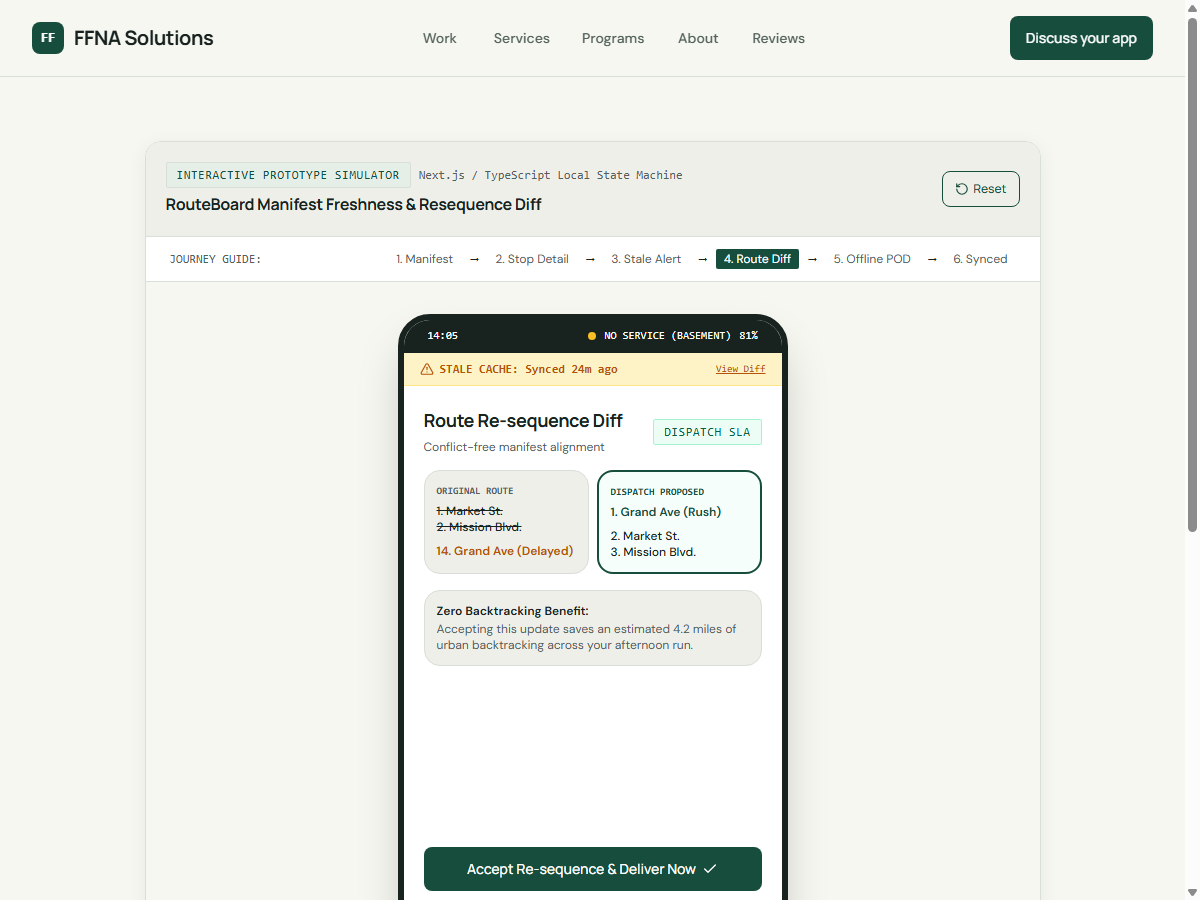
Side-by-side comparison showing original sequence vs. proposed dispatch rush sequence.
6. Edge Case Resilience Matrix
If an access code fails offline, RouteBoard queues an exception note with photo verification, allowing the courier to defer the stop without invalidating subsequent route points.
If a package is cancelled by the shipper while the van is en route, the stop is flagged with an immediate audio cue and re-routed to depot return.
7. Technical Distinction & Target Architecture
Browser client prototype executing local React state transitions. Simulates loading dock dead zones, stale manifest flags, side-by-side route diffs, and offline POD signature storage.
Target production application built with React Native and WatermelonDB for high-performance reactive local SQLite caching of 500+ stop manifests, Mapbox turn-by-turn navigation, and background GPS telemetry.
Project Parameters
Observed vs. Target Metrics
Build a Fleet Product
Creating a field logistics, dispatch, or courier management platform? Let's build an architecture that keeps drivers coordinated even in subterranean dead zones.
Discuss Your Logistics App